.png)
POST-DOC
PHILIP PARNAMETS - NYU Social Psychology Postdoctoral Fellow
Philip completed his PhD in cognitive science at Lund University and has spent two years as a postdoc with the Emotion Lab at Karolinska Institutet. His research is grounded in a broad interest in the cognitive and computational mechanisms underlying preference change, decision making and learning, especially in the moral domain. In the Social Identity and Morality lab his work focuses on dynamic models of social learning about moral agents and of moral choices generally. Philip spends his spare time creating, listening or dancing to electronic music.
New York University
Director: Jay Van Bavel


ABOUT JAY
Jay Van Bavel is a Professor of Psychology & Neural Science at New York University, an affiliate at the Stern School of Business in Management and Organizations, Professor at the Norwegian School of Economics, and Director of the Center for Conflict & Cooperation. He is also an Associate Editor of the Proceedings of the National Academy of Sciences Nexus. Jay completed his PhD at the University of Toronto and a Postdoctoral Fellowship at The Ohio State University.
He studies how shared identities and beliefs can unite people—or drive them apart—and what this reveals about the human mind and society. Specifically, his research examines intergroup conflict and polarization, cooperation and collective intelligence, moral judgment and decision-making, belief formation and misinformation, and the impact of social media and artificial intelligence. His work uses a range of methods spanning social and political psychology, computational social science, cognitive neuroscience, and cross-cultural analysis.
Jay has published over 150 academic papers (including in Science, Nature, PNAS) and is a Clarivate highly cited researcher (in the top 1% of researchers worldwide). He co-authored The Power of Us: Harnessing Our Shared Identities to Improve Performance, Increase Cooperation, and Promote Social Harmony (winner of the APA William James Book Award). His work has also been cited in the US Supreme Court and Senate and he has consulted with the White House, United Nations, European Union, and World Health Organization.
Jay is an active science communicator with over 100,000 social media followers. He writes the Power of Us newsletter and has written for The New York Times, BBC, The Atlantic, Scientific American, The Wall Street Journal, Guardian, LA Times, TIME, and The Washington Post. He has given talks at dozens of psychology departments and business schools, as well as academic conferences, professional events, and non-academic organizations (including the World Bank, World Science Festival, Aspen Ideas Festival, The Atlantic Festival, and TEDx).
Jay teaches courses on Social Psychology, Social Neuroscience, Attitudes and Evaluation, Intergroup Relations, Group Identity, Moral Psychology, Professional Development, and Introduction to Psychology. He received the NYU Golden Dozen Teaching Award for teaching excellence. He also co-founded a mentoring column for Science Magazine and has created several educational videos (e.g., TED-Ed).
He has received several awards, including the Young Investigator Award for distinguished contributions in social neuroscience from the Society for Social Neuroscience, the Young Scholars Award for outstanding achievements in social and personality psychology from the Foundation for Personality and Social Psychology, the Janet T. Spence Award for Transformative Early Career Contributions from the Association for Psychological Science, the F.J. McGuigan Early Career Investigator Prize from the American Psychological Foundation, the Gordon Allport Intergroup Relations Prize, and the SPSP Wegner Theoretical Innovation Prize and Cialdini Prize.
Jay’s work has been generously supported by the National Science Foundation, Russell Sage Foundation, American Psychological Foundation, Society for Personality and Social Psychology, Social Sciences and Humanities Research Council, John Templeton Foundation, Templeton World Charity Foundation, Society for the Psychological Study of Social Issues, AE Foundation, Google Jigsaw, and Norwegian Research Council.


FEATURED PUBLICATIONS
Robertson, C. E., Pröllochs, N., Schwarzenegger, K., Pärnamets, P., Van Bavel, J. J., & Feuerriegel, S. (2023). Negativity drives online news consumption. Nature Human Behaviour, 1-11. [PDF]
Rathje, S., Roozenbeek, J., Van Bavel, J. J., & van der Linden, S. (2023). Accuracy and social motivations shape judgements of (mis) information. Nature Human Behaviour, 1-12. [PDF]
Van Bavel, J. J., Cichocka, A., Capraro, V., Sjåstad, H., Nezlek, J. B., Pavlović, T., Alfano, M., Gelfand, M. J., Azevedo, F., Birtel, M. D., Cislak, A., Lockwood, P. L., Ross, R. M., Abts, K., Agadullina, E., Aruta, J. J. B., Besharati, S. N., Bor, A., Choma, B. L., … Boggio, P. S. (2022). National identity predicts public health support during a global pandemic. Nature Communications, 13(1), 517. [PDF]
Van Bavel, J. J., Rathje, S., Harris, E., Robertson, C., & Sternisko, A. (2021). How social media shapes polarization. Trends in Cognitive Sciences, 25(11), 913-916 [PDF]
*Rathje, S., Van Bavel, J. J., & van der Linden, S. (2021). Out-group animosity drives engagement on social media. Proceedings of the National Academy of Sciences. [PDF]
Gollwitzer, A., *Martel, C., *Brady, W. J., Parnamets, P., Freedman, I. G., Knowles, E. D., & Van Bavel, J.J. (2020). Partisan differences in physical distancing are linked to health outcomes during the COVID-19 pandemic. Nature Human Behavior, 4, 1186-1197. [PDF]
Finkel, E. J., Bail, C. A., Cikara, M., Ditto, P. H., IIyengar, S., Klar, S., Mason, L., McGrath, M. C., Nyhan, B., Rand, D., Skitka, L., Tucker, J. A., Van Bavel, J.J., Wang, C. S. & Druckman, J. N. (2020). Political sectarianism in America: A poisonous cocktail of othering, aversion, and moralization. Science. [PDF]
Van Bavel, J.J.,, Baicker, K., Boggio, P. S., Capraro, V., Cichocka, A., Cikara, M., Crockett, M. J., Crum, A. J., Douglas, K. M., Druckman, J. N. Drury, J., Dube, O., Ellemers, N., Finkel, E. J., Fowler, J. H., Gelfand, M., Han, S., Haslam, S. A., Jetten, J., Kitayama, S., Mobbs, D., Napper, L. E., Packer, D. J., Pennycook, G., Peters, E., Petty, R. E., Rand, D. G., Reicher, S. D., Schnall, S., Shariff, A., Skitka, L. J., Smith, S. S., Sunstein, C. R., Tabri, N., Tucker, J. A., van der Linden, S., Van Lange, P. A. M., Weeden, K. A., Wohl, M. J. A., Zaki, J., Zion, S. & Willer, R. (2020). Using social and behavioural science to support COVID-19 pandemic response. Nature Human Behaviour. [PDF]
Van Bavel, J.J. & Pereira, A. (2018). The partisan brain: An identity-based model of political belief. Trends in Cognitive Sciences, 22, 213-224. [PDF]
Brady, W.J., Wills, J.A., Jost, J.T., Tucker, J.A., & Van Bavel, J.J. (2017). Emotion shapes the diffusion of moralized content in social networks. Proceedings of the National Academy of Sciences, 1-6. [PDF]
Dikker, S., Wan, L., Davidesco, I., Kaggen, L., Oostrik, M., McClintock, J., Rowland, J., Van Bavel, J.J., Ding, M., & Poeppel, D. (2017). Brain-to-brain synchrony tracks real-world dynamic group interactions in the classroom. Current Biology, 27, 1375-1380. [PDF]
Van Bavel, J.J., FeldmanHall, O., & Mende-Siedlecki, P. (2015). The neuroscience of moral cognition: From dual process to dynamic systems. Current Opinion in Psychology, 6, 167-172. [PDF]
Cikara, M., & Van Bavel, J.J. (2014). The neuroscience of intergroup relations: An integrative review. Perspectives on Psychological Science, 9, 245-274. [PDF]
Van Bavel, J.J., Packer, D.J., & Cunningham, W.A. (2008). The neural substrates of in-group bias: A functional magnetic resonance imaging investigation. Psychological Science, 19, 1131-1139. [PDF]
RESEARCH
My program of research over the past two decades explores the dynamics of shared, social identities (Van Bavel & Packer, 2021). My work is grounded in the notion that our sense of self is derived from our social environment. We flexibly form social identities with groups, from partisan to university to national affiliations, and these identities have a profound influence on how we think and act in the world—providing a lens through which we interpret the social world. My lab examines what happens to people psychologically when they define themselves in terms of group memberships, from our most rapid evaluations and verbal expressions to belief updating and behavior.
Drawing upon research in social psychology and cognitive neuroscience, as well as the social sciences more generally, I have been focused on a set of core principles about social identity. This has led my work to evolve from using implicit measures of social judgments and functional neuroimaging of face perception to economic cooperative games and linguistic analysis of social media posts, and, more recently, to studying the movement of millions of people and using international surveys of public health behavior during the pandemic. By triangulating across methods, I have developed a deeper understanding of how identity shapes human cognition and action across a wide range of domains.
You can read a full description of my research program on my lab website.
SPEAKING

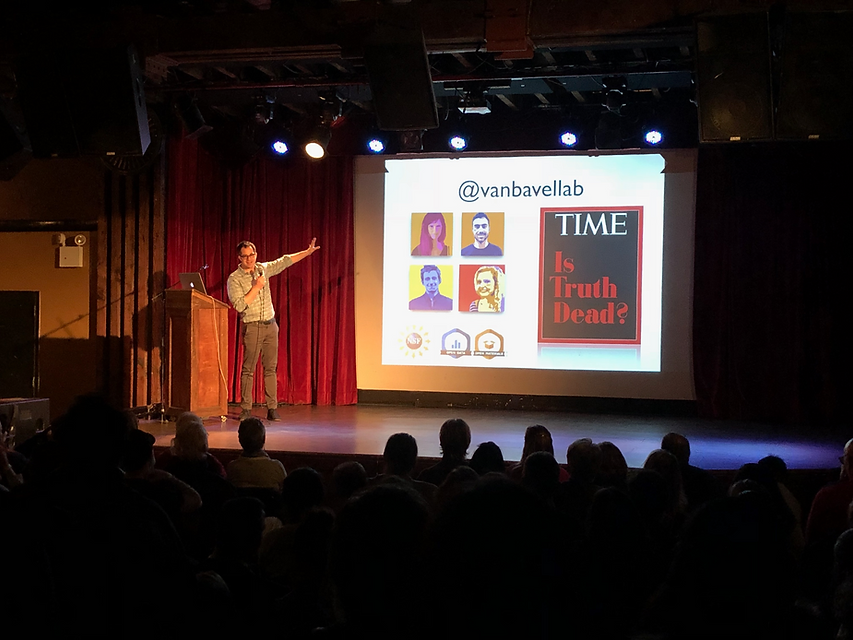
Jay has been invited to speak at many psychology departments and business schools (e.g., Stanford, Harvard, Princeton, Cambridge, Zurich), international conferences (e.g., TEDx, Aspen Ideas Festival, World Health Organization, World Science Festival), organizations (e.g., New York Times, International Science Council, National Academy of Medicine), government agencies (e.g., U.S. White House, Senate and House or Representatives), and Fortune 500 companies (e.g., Amazon, Microsoft, General Mills, Uber, Merck, Gilead).
TEACHING
"The mind is not a vessel to be filled but a fire to be kindled"
Plutarch

NYU Abu Dhabi Social Chameleons course taught with Tessa West, 2017
I believe that higher education should be focused on developing passionate, critical, independent and creative thought, and the transmission of knowledge should be in the service of developing these skills. In the classroom (and occasionally, from an elevator), I try to communicate the core issues and controversies within an area in an interactive fashion, drawing students into the material though exercises and debate. This experience provides a deeper understanding of the material and encourages students to think critically about how scientific conclusions depend on the research process. In addition, I try to teach case studies of scientific controversy on topical issues to illustrate that science is not simply an assembly of facts but a method for developing and testing ideas. In my experience, this approach has led naturally to classroom discussions where students share their own insights and critical perspectives.
BOOK
Harnessing Our Shared Identities to Improve Performance, Increase Cooperation, and Promote Social Harmony
“The Power of Us compellingly debunks many of the myths that have arisen not only around social identity research but also around social psychology as a whole. Of these, the most enduring are those that paint groups as inevitable sites for corruption of self and loss of reason. The triumph of this book is how it shows that this framing is not only wholly wrong but also dangerously misleading…if we are to have functional and resilient organizations, institutions, and societies, we must understand and draw from the power of collective mind.”


CONTACT
For all lab-related and teaching inquiries, including inquiries about joining the lab, please see the contact page on my lab website.
For podcast or event inquiries related to The Power of Us, please fill out this brief form. For other inquiries related to The Power of Us, please fill out the form on my book website.
For all other inquiries, please fill out the form below: